
If you are endlessly searching for the best way to lose weight, you have likely encountered countless restrictive diets, exhausting workout regimens, and dubious pills.
The truth is, most people fail to keep the weight off because they rely on temporary solutions for a permanent problem. To achieve genuine body fat reduction, you must abandon the desire to lose weight fast and embrace sustainable lifestyle changes.
This guide provides a scientifically grounded, real-world roadmap to optimizing your metabolism, controlling your appetite, and achieving lasting fat loss.
5 Key Takeaways:
The best way to lose weight sustainably depends on maintaining a consistent calorie deficit over time, rather than relying on extreme diets.
Most diets fail due to poor adherence and restrictive rules, not because the underlying physiological method is ineffective for body fat reduction.
Hunger, metabolism, and daily habits—including sleep and stress management—play a major role in your fat loss success.
Attempts to lose weight fast often lead to severe metabolic adaptation and rebound weight gain if not managed properly.
Long-term success requires fundamental behavior change, transitioning from a temporary diet phase into a permanent lifestyle and maintenance phase.
What Is Sustainable Weight Loss Through Lifestyle Changes?
Sustainable weight loss through lifestyle changes is the process of gradually reducing body fat by permanently adopting healthier eating, consistent daily movement, and positive mindset shifts.
In practical terms, it means making daily choices you can actually live with for years, rather than starving yourself for a few weeks.
Scientifically, this approach prevents the severe metabolic adaptation (a slowing metabolism) and extreme appetite spikes that occur during crash dieting. Unlike scams that promise you will lose weight fast, a lifestyle approach ensures that your body fat reduction is steady, safe, and easily maintained.
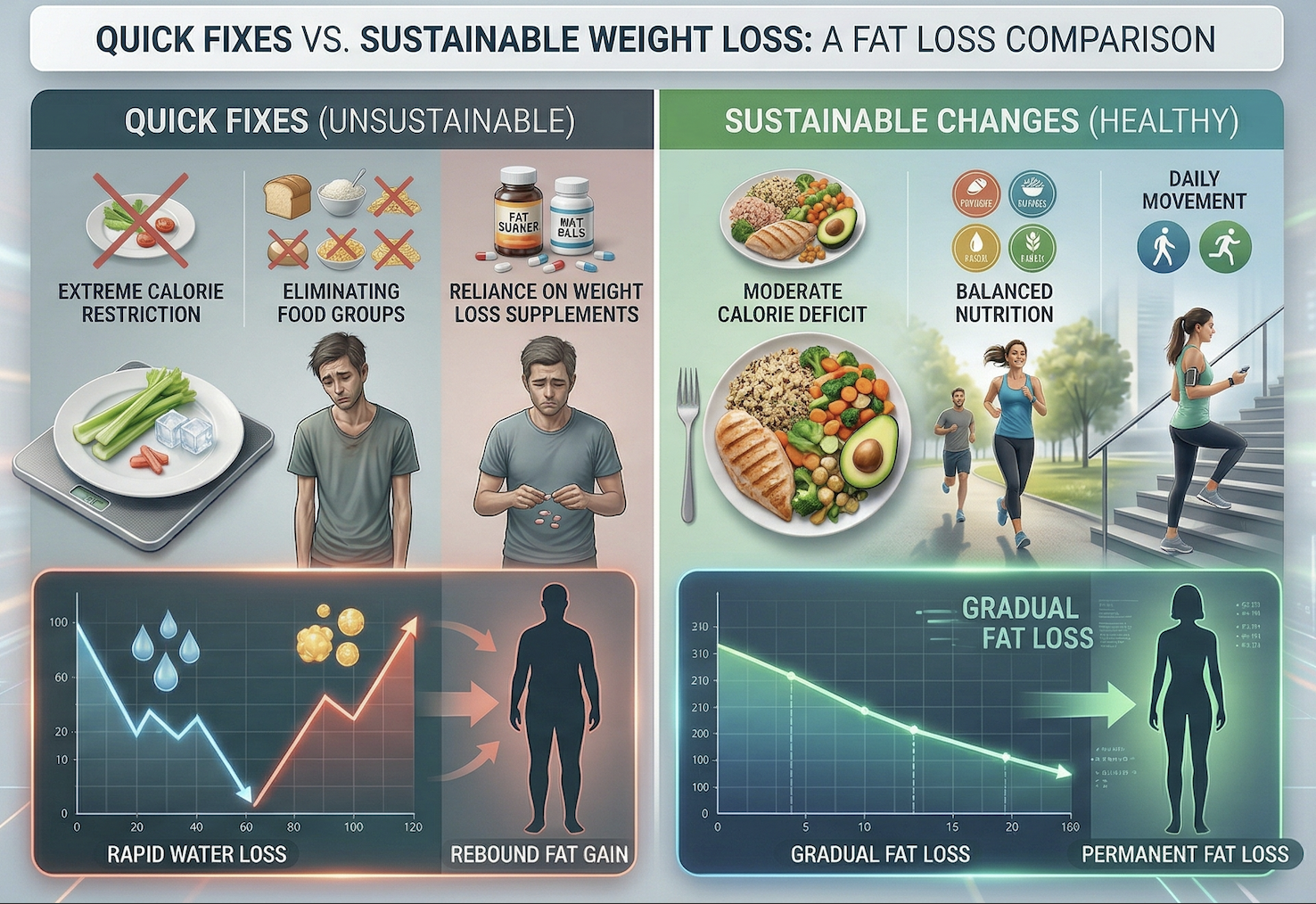
QUICK FIXES VS SUSTAINABLE WEIGHT LOSS
Why Is Sustainable Weight Loss the Best Way to Lose Weight and Keep It Off?
Sustainable weight loss is the best way to lose weight and keep it off because it fundamentally changes your daily habits, preventing the rebound weight gain associated with restrictive fad diets.
Practically, when you do not feel deprived, you are less likely to binge eat or abandon your routine. Biologically, losing a modest 1 to 2 pounds per week preserves lean muscle mass, which keeps your resting metabolism high.
Furthermore, even a modest 5% weight loss dramatically lowers your risk for heart disease, type 2 diabetes, and joint pain. If you are looking for the absolute best way to lose weight, evidence-based habit change is the definitive answer.
Checklist: Assessing Your Readiness for the Best Way to Lose Weight
Do I have a genuine desire to change my daily habits, or just my appearance?
Am I currently managing my stress levels effectively without using food?
Do I have the time to commit to basic meal prep and 30 minutes of daily exercise?
Am I willing to accept slow, steady progress instead of trying to lose weight fast?
How Do I Prepare Mentally for Weight Loss? (Readiness and Mindset)
You prepare mentally for weight loss by assessing your true desire to change, identifying how you cope with stress, and committing the necessary time to build new habits.
Mental preparation is the foundation of any successful fat loss journey. In the real world, this means accepting that you will have hard days and planning for them in advance.
Psychologically, it involves shifting your mindset from "dieting" to "nourishing." When stress hits, cortisol levels rise, which can increase appetite and drive emotional eating. Preparing alternative stress-coping mechanisms, like going for a walk, journaling, or calling a friend, protects your calorie deficit from emotional binges.
Downloadable Mindset Worksheet Prompts:
1. What are my top three non-scale victories I want to achieve?
2. When I feel stressed, what are two non-food activities I can do to calm down?
3. What is the biggest obstacle that derailed my past weight loss attempts, and how will I bypass it this time?
How Fast Should You Aim to Lose Weight?
You should aim to lose 1 to 2 pounds (0.5 to 1 kg) per week for the most sustainable and healthy results.
While the temptation to lose weight fast is common, rapid weight loss often results in muscle loss and rebound weight gain. Losing just 5% of your total body weight is a clinically significant milestone. For a 200-pound person, a 10-pound reduction dramatically lowers blood pressure, improves cholesterol profiles, and stabilizes blood sugar, significantly reducing the risk of type 2 diabetes and heart disease.
How Does the Body Actually Burn Fat?
The body burns fat by converting stored triglycerides into usable energy when it experiences a sustained calorie deficit.
TL;DR: When you eat fewer calories than you burn, your body unlocks stored fat, converts it to energy, and you exhale the byproduct as carbon dioxide.
Practically, when you eat less and move more, your body looks for alternative fuel sources to keep you going. Scientifically, this process is called lipolysis and beta-oxidation. A calorie deficit lowers insulin levels, signaling fat cells to release stored fatty acids into the bloodstream. These fatty acids are transported to your muscles and organs, where your mitochondria burn them for energy.
How Do Hormones, Sleep, and Stress Impact Fat Storage?
Poor sleep and high stress elevate cortisol and disrupt hunger hormones, making your body aggressively store fat and increase cravings.
In the real world, a bad night of sleep makes you crave sugary, high-calorie foods the next day. On a biological level, sleep deprivation lowers leptin (the hormone that signals fullness) and spikes ghrelin (the hormone that signals hunger).
Simultaneously, chronic stress elevates cortisol, which promotes insulin resistance and directs the body to store excess calories specifically as visceral belly fat.
How Many Calories Do You Need to Cut to Lose Weight?
You need to cut your daily caloric intake by 500 to 750 calories below your maintenance level to achieve a steady, sustainable fat loss.
Practically, this means eating slightly smaller portions, swapping high-calorie snacks for high-volume whole foods, or adding physical activity to increase your daily burn. Scientifically, energy balance dictates body mass; controlling this energy input is the fundamental law of any successful body fat reduction phase.
What Does a 500 to 750 Calorie Deficit Look Like?
A daily deficit of 500 to 750 calories translates to burning roughly 3,500 to 5,250 calories per week, which yields about 1 to 1.5 pounds of fat loss.
One pound of body fat contains approximately 3,500 calories of stored energy. To tap into this reserve, you must force the body to make up the difference. You can achieve this deficit by reducing your food intake by 500 calories, or by combining a 250-calorie food reduction with an extra 250 calories burned through exercise.
How Do You Track Your Food Without Psychological Burnout?
You can track your food without burnout by using habit-based tracking, mindful eating techniques, and simple food diaries instead of obsessively logging every gram in macro-tracking apps.
While strict calorie counting is highly effective for fat loss, it carries severe downsides, including psychological fatigue, anxiety, and a strained relationship with food. Instead of weighing every morsel, focus on the environment and speed of your eating.
Checklist for Mindful Eating Habits:
Eat meals at a table, completely free from TV or smartphone distractions.
Chew each bite thoroughly to slow down the eating process.
Pause halfway through the meal to assess your physical fullness.
Stop eating when you feel 80% full, rather than stuffed.
Drink a large glass of water 15 minutes before every meal.
What Should You Eat to Maximize Fat Loss?
To maximize fat loss, you should eat a diet rich in high-fiber plant-based foods, lean proteins, and healthy fats that control your appetite while keeping calories low.
Dietary strategy isn't just about cutting calories; it is about managing hunger. If you are constantly starving, you will eventually quit. Structuring your nutrition around foods that provide maximum volume for minimal calories is the key to adherence.
How Do Plant-Based Foods, Fiber, and Protein Control Appetite?
Plant-based foods, fiber, and protein control appetite by physically stretching the stomach, slowing digestion, and stabilizing blood sugar levels.
Practically, eating a large chicken salad keeps you full for hours, whereas a donut leaves you hungry 30 minutes later. Scientifically, fiber adds bulk to your digestive tract without adding digestible calories. Protein is the most satiating macronutrient; it reduces ghrelin (hunger hormone) and boosts peptide YY, a hormone that makes you feel full. [Internal Link: The Ultimate Guide to High-Protein Diets]
Low-Carb vs. Low-Fat vs. Plant-Based: Which Diet is Best for Fat Loss?
The best diet for fat loss is the one that allows you to consistently maintain a calorie deficit while enjoying your food and fitting your lifestyle.
No single diet possesses a magical metabolic advantage for body fat reduction. The most effective weight loss program is the one you can stick to for months, not days.
| Diet Approach | Primary Mechanism | Pros for Fat Loss | Cons & Risks |
| :--- | :--- | :--- | :--- |
| Low-Carb / Keto | Restricts carbohydrates to lower insulin and reduce water weight. | High satiety from fats/proteins; rapid initial water weight loss. | Can be highly restrictive; may lower energy for intense exercise. |
| Low-Fat | Restricts calorie-dense dietary fats to lower overall energy intake. | Easy to eat large volumes of food (carbs/protein); great for athletes. | Can leave you feeling less satiated; may impact hormone production if fats are too low. |
| Plant-Based / Vegan | Eliminates animal products, naturally increasing fiber intake. | High fiber leads to excellent fullness; generally low in calorie density. | Requires careful planning to ensure adequate protein and B12 intake. |
What Does a Realistic Weekly Meal Plan and Grocery List Look Like?
A realistic meal plan prioritizes whole foods, lean proteins, and complex carbohydrates while allowing for flexibility and minimal prep time.
3-Day Sample Fat Loss Meal Plan:
Day 1:
Breakfast: Oatmeal made with water, topped with half a sliced apple and a scoop of whey protein.
Lunch: Large spinach salad with grilled chicken breast, cherry tomatoes, and 1 tbsp olive oil vinaigrette.
Dinner: Baked salmon, half a cup of quinoa, and roasted broccoli.
Day 2:
Breakfast: 3 scrambled egg whites and 1 whole egg with a slice of whole-wheat toast.
Lunch: Turkey wrap using a whole-grain tortilla, hummus, and mixed greens.
Dinner: Lean ground beef chili with kidney beans and diced tomatoes.
Day 3:
Breakfast: Greek yogurt (fat-free) mixed with a handful of berries and chia seeds.
Lunch: Leftover chili from Day 2.
Dinner: Grilled chicken thigh, roasted sweet potato wedges, and asparagus.
How Much Exercise is Required to Lose Body Fat?
You should aim for at least 30 minutes of aerobic exercise most days of the week, combined with two days of strength training, to optimize fat loss and preserve muscle.
While you can technically lose weight through diet alone, exercise drastically improves your results. Exercise burns calories, increases your daily energy expenditure, and improves your metabolic health.
Aerobic Exercise vs. Strength Training: Which is Better for Long-Term Fat Loss?
Strength training is better for long-term fat loss because it builds muscle, which permanently increases your resting metabolism, while aerobic exercise is better for immediate daily calorie burning.
TL;DR: Cardio burns calories while you do it; lifting weights builds muscle that burns calories 24/7.
For the best results, you need both. Aerobic exercise (like brisk walking or cycling) creates an immediate energy deficit. Strength training (lifting weights, pushups, resistance bands) prevents the body from breaking down muscle tissue during a calorie deficit, ensuring the weight you lose is strictly body fat.
What is a Beginner-Friendly Weekly Workout Routine?
A beginner-friendly routine balances light cardiovascular work with basic, full-body resistance exercises to build a habit without causing excessive soreness.
Monday: 30-minute brisk walk (Aerobic).
Tuesday: 20-minute full-body strength (bodyweight squats, pushups on knees, dumbbell rows).
Wednesday: Active rest (light stretching or a 15-minute walk).
Thursday: 30-minute brisk walk or cycling (Aerobic).
Friday: 20-minute full-body strength (lunges, planks, glute bridges).
Weekend: Active hobbies (hiking, gardening, swimming).
How Can You Increase Daily Movement Without Going to the Gym?
You can increase daily movement by modifying your environment to force extra steps, standing, and general physical activity throughout your normal routine.
This is known as Non-Exercise Activity Thermogenesis (NEAT), and it accounts for a massive portion of your daily calorie burn.
Park at the far end of the parking lot.
Take the stairs instead of the elevator.
Stand up or pace while talking on the phone.
Walk laps around the room during TV commercial breaks.
Do Weight Loss Supplements, Fat Burners, and Programs Actually Work?
Most over-the-counter weight loss supplements do not work, but evidence-based commercial programs and federally approved weight loss injections can be highly effective when combined with lifestyle changes.
The market is flooded with quick fixes, but sustainable body fat reduction requires distinguishing between marketing hype and medical science.
Are Over-the-Counter Fat Burners and Weight Loss Supplements Safe or Effective?
Over-the-counter fat burners and weight loss supplements are largely ineffective, unregulated, and cannot override a poor diet or a lack of a calorie deficit.
Many people turn to weight loss supplements to lose weight fast, but these products mostly rely on high doses of caffeine and diuretics. They may cause a temporary drop in water weight and a slight metabolic boost, but they do not oxidize body fat. Furthermore, they carry risks of increased heart rate, anxiety, and digestive issues. Save your money and focus on nutrition.
Are Commercial Weight Loss Programs Worth the Investment?
Commercial weight loss programs are worth the investment if they provide registered dietitians, community support, and focus on habit formation rather than just selling branded meals.
The best weight loss program for you is one that offers accountability. Clinical and community support groups significantly increase adherence. However, if a program requires you to buy their specific processed foods forever, it is not teaching you sustainable lifestyle changes.
How Do Federally Approved Weight-Loss Medications and GLP-1s Support Fat Loss?
Federally approved weight loss injections (like GLP-1 agonists) support fat loss by delaying gastric emptying and signaling the brain to drastically reduce appetite and cravings.
TL;DR: Weight loss medications don't magically burn fat; they alter hunger hormones so that sticking to a calorie deficit becomes effortless.
For individuals with genetic or hormonal roadblocks, sheer willpower is often not enough. Medications like semaglutide and tirzepatide have revolutionized the treatment of obesity. However, they are not a replacement for nutrition and exercise. If you rely solely on medications without building healthy habits, you will likely lose muscle mass and face rebound weight gain if you ever stop the medication. [2]
Why Do Weight Loss Plateaus Happen and How Can You Overcome Them?
Weight loss plateaus happen because your body adapts to your lower calorie intake and reduced body mass by slowing down your metabolism to defend against further weight loss.
Hitting a plateau is a normal, guaranteed part of the fat loss journey. It does not mean you are failing; it means your body is functioning correctly to prevent starvation.
What is Metabolic Adaptation (Metabolic Slowdown)?
Metabolic adaptation is the biological process where your body burns fewer calories at rest and during movement because you now weigh less and your body is trying to conserve energy.
Practically, the diet that helped you lose your first 10 pounds will not be enough to help you lose the next 10 pounds. Scientifically, as you lose body fat, your resting metabolic rate drops. Furthermore, your brain subconsciously reduces your daily fidgeting and movement (NEAT) to save energy.
Why Am I Not Losing Weight Despite Eating Less?
You may not be losing weight due to inaccurate calorie tracking, hidden calories in condiments, overestimating how many calories you burn exercising, or heavy water retention masking your fat loss.
If the scale hasn't moved in weeks, audit your habits. Are you eyeballing portion sizes? Are you using heavy pours of olive oil? Often, people eat more than they realize and move less than they think. Alternatively, high cortisol from diet-induced stress can cause severe water retention, masking true body fat reduction on the scale.
What Should You Do If You Experience a Setback or Binge?
If you experience a setback, you should immediately forgive yourself, hydrate, and return to your normal nutrition plan at the very next meal without attempting to "punish" yourself with extreme fasting or cardio.
The behavioral psychology of setbacks dictates that guilt leads to further bingeing. One bad meal will not ruin a month of consistency, just as one salad will not make you lean. Do not slash your calories the next day. Simply start fresh.
How Do You Stay Motivated and Build Habit-Based Lifestyle Changes?
You stay motivated by relying on structured habits, modifying your environment to remove temptations, and setting specific, actionable goals rather than focusing solely on the scale.
Motivation is an emotion, and it will inevitably fade. Discipline and habit are what carry you through the days you don't feel like eating healthy or going to the gym.
What is the Difference Between Action Goals and Outcome Goals?
An outcome goal is the final result you want to achieve (e.g., "lose 10 pounds"), while an action goal is the specific, daily behavior required to get there (e.g., "walk 15 minutes a day").
Focusing only on the outcome goal can leave you feeling defeated if the scale doesn't move fast enough. Action goals are entirely within your control. If you consistently hit your action goals, the outcome goal will eventually take care of itself.
How Can You Overcome Environmental Challenges and Triggers?
You can overcome environmental challenges by anticipating them in advance and creating a specific plan to avoid or navigate high-calorie triggers.
Willpower is a finite resource. If you keep junk food on your counter, you will eventually eat it.
Challenge vs. Solution Checklist:
Challenge: Coworkers bring sugary donuts to the office.
Solution: Keep high-protein snacks (like Greek yogurt or almonds) at your desk so you are never overly hungry.
Challenge: You buy junk food "for the kids."
Solution: Stop buying it. Bring the family together to make healthier choices, or buy treats you personally do not enjoy.
Challenge: Too tired to work out after work.
Solution: Pack your gym bag the night before and go straight to the gym, or switch to morning workouts.
How Do You Maintain Weight Loss and Prevent Rebound Weight Gain?
You maintain weight loss by intentionally transitioning out of a calorie deficit and finding your new maintenance calories while keeping up your newly formed exercise and nutrition habits.
The biggest mistake dieters make is viewing their nutrition plan as a temporary fix. Once they hit their goal weight, they return to their old eating habits, resulting in rapid weight regain.
What is the Maintenance Phase in a Nutrition Strategy?
The maintenance phase is the period where you intentionally consume the exact number of calories your body burns daily, keeping your weight perfectly stable.
You cannot stay in a calorie deficit forever; doing so will severely damage your metabolism and hormones. The maintenance phase requires you to stop losing weight and focus on sustaining your new, leaner physique.
How Do You Transition Out of a Calorie Deficit Safely?
You transition safely by using a process called "reverse dieting," which involves slowly adding 100 to 200 calories back into your daily intake each week until your weight stabilizes.
This slow reintroduction of food allows your metabolism to speed back up and your hormones to normalize without causing a massive influx of rapid fat storage.
Can You Maintain Results Long-Term with This Strategy?
Yes, you can maintain results long-term if you permanently adopt the mindful eating, physical activity, and stress management habits you built during your weight loss phase.
Research shows that the people who successfully keep weight off long-term are those who continue to weigh themselves periodically, maintain a high-protein diet, and engage in regular physical activity.