2026 Fusion Energy Breakthroughs: Global Impact & Outlook
For decades, it was the ultimate promise of science fiction: clean, safe, and virtually limitless energy from the same process that powers the sun. Now, in a year that will be etched in history, 2026 is when nuclear fusion moved from theoretical promise to tangible reality. A rapid succession of breakthroughs has fundamentally altered the timeline for humanity’s energy future. This article breaks down the specific 2026 fusion energy breakthroughs, their global impact on our economy and environment, and provides a realistic outlook on the road ahead. These developments are far more than scientific curiosities; they represent a genuine turning point for tackling climate change, reshaping geopolitics, and unlocking a new era of human progress.
The Game-Changing Fusion Advances of 2026
The story of 2026 isn’t about a single “eureka” moment but rather a convergence of three critical advancements. These breakthroughs, achieved by international collaborations and pioneering private firms, collectively solved a puzzle that has stumped scientists for over 70 years. They directly address the core challenges that kept fusion power locked away in the realm of theory.
Here are the specific advances that made 2026 a landmark year for fusion energy:
1. Sustained Net Energy Gain Becomes Repeatable
The first domino fell in early 2026. Building on the landmark “ignition” experiments from earlier in the decade, a consortium of researchers at a next-generation tokamak facility demonstrated sustained net energy gain for the first time. While previous experiments had produced more energy than they consumed for mere fractions of a second, this new milestone saw a fusion reaction sustain itself, producing a significant net power output for over five continuous minutes.
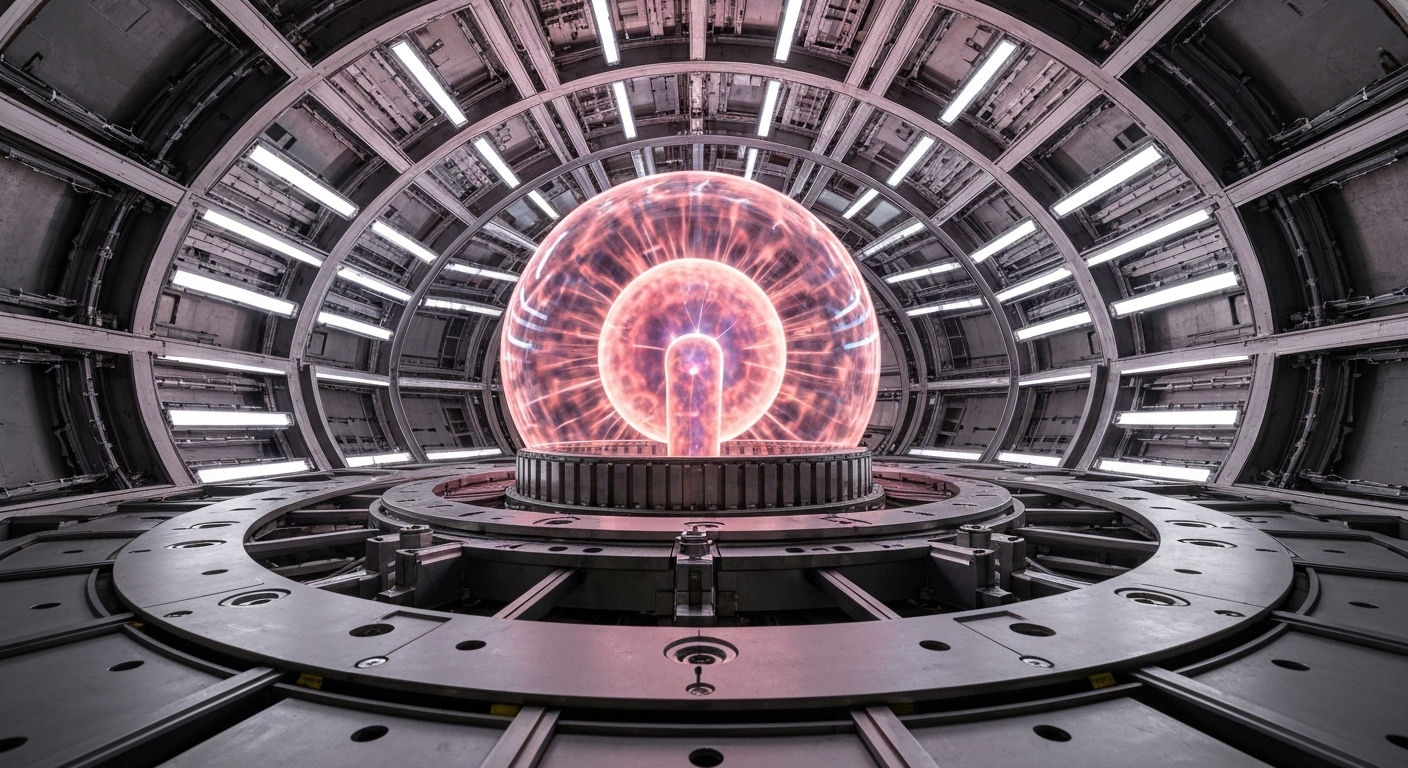
This was achieved by combining a refined magnetic confinement strategy with a novel heating system that allowed the plasma—the superheated gas of hydrogen isotopes—to maintain its fusion-ready temperature of over 150 million degrees Celsius without constant, massive energy inputs. This repeatable success proved that a fusion power plant could, in principle, operate as a true power source rather than a power-consuming experiment.
2. AI Unlocks Unprecedented Plasma Stability
The second major advance came from the world of artificial intelligence. Fusion plasmas are notoriously volatile and difficult to control, prone to instabilities that can extinguish the reaction in milliseconds. A team of physicists and data scientists unveiled a sophisticated AI control system that has largely solved this problem.
Trained on petabytes of experimental data from reactors around the world, the AI can predict the formation of plasma instabilities with 99% accuracy and proactively adjust the reactor’s magnetic fields to quell them before they disrupt the reaction. This AI-driven stability control is the key that transforms fusion reactors from delicate, temperamental experiments into robust, reliable power-generating machines. It’s the equivalent of giving a pilot an autopilot that can react faster than humanly possible to any turbulence.
3. A Revolution in Materials Science
Finally, the third breakthrough solved one of fusion’s most practical and expensive problems: materials. The intense heat and neutron bombardment inside a reactor can degrade components rapidly, making long-term operation economically unfeasible. In mid-2026, materials scientists announced the development of a new tungsten-based composite, nicknamed “helios-carbide.”
This new material demonstrates remarkable resistance to neutron damage and can withstand the extreme thermal loads at the reactor’s “divertor”—the exhaust system for the plasma. Early tests show that components made from helios-carbide could last for years instead of months, drastically reducing the projected operating costs and maintenance downtime for a future fusion power plant. This innovation in materials science makes the economics of fusion power finally look viable.
Reshaping the Global Economy: Fusion’s Economic Ripple Effect
With the scientific viability now firmly established, the economic implications of the 2026 breakthroughs are beginning to unfold. We are witnessing the birth of an entirely new “fusion economy,” and its ripple effect will be felt across every sector.
The most immediate impact has been a massive influx of investment. Venture capital, which had been cautiously trickling into private fusion startups, has become a torrent. Governments are redoubling their funding for national labs and public-private partnerships, viewing fusion leadership as a matter of economic destiny. This capital is funding the construction of the first generation of demonstration power plants (DEMOs), creating tens of thousands of high-skilled jobs in engineering, physics, materials science, and advanced manufacturing.
In the medium term, the prospect of cheap, abundant energy is set to upend existing energy markets. As fusion power becomes a reality, the value of carbon-based fuel reserves will be fundamentally reassessed. Industries that are heavily reliant on energy—such as manufacturing, data centers, and transportation—can anticipate a future of dramatically lower and more stable operating costs. This could trigger a global re-industrialization in regions that can build out fusion infrastructure first, making energy-intensive processes like desalination and green hydrogen production economically trivial.
A Turning Point for Climate Change: Fusion’s Environmental Promise
For years, the path to net-zero emissions felt like an uphill battle, reliant on a complex and sometimes intermittent mix of renewables and storage. The 2026 fusion breakthroughs have fundamentally changed the equation, offering a direct, powerful tool to combat climate change.
Fusion energy’s environmental promise is profound:
- Zero-Carbon Power: Fusion reactors produce no carbon dioxide or other greenhouse gases. A fusion power plant generates electricity by converting mass into energy, with helium—an inert, harmless gas—as its primary byproduct.
- Baseload Reliability: Unlike wind and solar, fusion provides constant, reliable “baseload” power, 24/7, regardless of weather conditions. This eliminates the need for massive battery storage systems and provides the grid stability required to power a modern, electrified society.
- Minimal Land Footprint: A fusion power plant producing a gigawatt of electricity—enough to power a large city—would occupy only a few dozen acres. This is a fraction of the land footprint required for solar or wind farms of a similar capacity, preserving natural habitats and agricultural land.
- Inherent Safety: Fusion is not fission. There is no risk of a meltdown, as the reaction is inherently self-limiting; any disruption causes the plasma to cool and the reaction to stop instantly. Furthermore, it produces no long-lived, high-level radioactive waste, simplifying disposal and easing public concerns about nuclear energy.
With a clear pathway to commercial fusion, climate models are being revised. The goal of a fully decarbonized global power grid by 2050 has shifted from an ambitious aspiration to a plausible engineering challenge.
Redrawing the World’s Energy Map: The Geopolitical Impact
Energy has always been a cornerstone of geopolitics, and the dawn of the fusion age promises the most significant realignment of global power dynamics since the beginning of the oil age. The 2026 breakthroughs are not just a scientific victory; they are a geopolitical event.
The most significant shift will be the radical decentralization of energy production. The primary fuel for the first generation of fusion reactors—deuterium and lithium—is abundant and globally distributed. Deuterium can be extracted from seawater, and lithium, while currently concentrated in a few countries, is geologically widespread. This breaks the historic dependence on geographically concentrated fossil fuels, which has long been a source of international conflict and economic instability.
Nations that master fusion technology will gain unprecedented energy independence. They will no longer be vulnerable to price shocks, supply chain disruptions, or the political whims of petro-states. This new reality is already sparking a “fusion race,” with major world powers competing to build the first commercial reactors and set the technical standards for a global fusion-powered grid. The geopolitical map of the 21st century may not be drawn by oil fields and pipelines, but by the location of fusion research hubs and advanced manufacturing centers.
The Road to Commercial Fusion: What Happens Next?
While 2026 has been a year of breathtaking progress, it is crucial to maintain a realistic perspective. We have not yet built a commercial fusion power plant. The breakthroughs have proven the science is sound, but now the immense engineering challenge begins.
The path forward is now clearer and involves several key phases:
- Demonstration Plants (Late 2020s - Mid 2030s): The next step is to build several “DEMO” plants. These will be the first fusion reactors designed to operate like true power stations, exporting net electricity to the grid and testing the integrated systems—from fuel handling to power conversion—in a real-world environment. These projects will be critical for optimizing designs and proving commercial reliability.
- Regulatory Frameworks (Ongoing): Governments and international bodies must now create a new regulatory framework specifically for fusion energy. This will need to address safety, materials handling, and grid integration in a way that is distinct from the regulations governing traditional fission power plants.
- Supply Chain Development (2030s): Building a global fleet of fusion reactors will require a massive new supply chain for specialized components like high-temperature superconducting magnets, vacuum vessels, and the advanced materials developed this year. Scaling this industrial capacity will be a major undertaking.
- First Commercial Rollout (Early 2040s): Based on the lessons learned from the DEMO plants, experts now project that the first wave of commercial fusion power plants could begin connecting to grids in the early 2040s. This timeline, once considered wildly optimistic, is now a consensus view in the energy community.
The remaining challenges are significant, but they are now engineering and economic problems, not fundamental questions of physics.
Conclusion: The Dawn of the Fusion Age
The year 2026 will be remembered as the moment the starting gun was fired on the fusion age. The breakthroughs in sustained net energy gain, AI-driven plasma control, and durable materials have transformed fusion from a distant dream into an achievable reality. The global impact will be nothing short of transformative, promising to reshape our economy, rescue our climate, and redraw the map of global power.
The path to a fusion-powered world is still a marathon, not a sprint. But for the first time, the finish line is in sight. We have moved from asking “if” fusion is possible to asking “when” it will power our world. The journey to a fusion-powered world is one of the most important stories of our time, and staying informed on the next phase of this energy revolution is key to understanding the future we are now building.
Frequently Asked Questions
What made the 2026 fusion energy breakthroughs so significant?
The 2026 breakthroughs marked a pivotal moment where fusion energy transitioned from theoretical promise to a tangible, viable energy source. These advances demonstrated consistent net energy gain and scalability, proving that a fusion-powered future is within reach and establishing 2026 as the year fusion energy became a reality.
What is the projected global economic impact of these 2026 fusion energy breakthroughs?
The breakthroughs are expected to trigger a massive economic ripple effect, creating new industries, jobs, and investment opportunities globally. They promise to stabilize energy costs, reduce reliance on volatile fossil fuel markets, and foster unprecedented economic growth, reshaping the global economy.
How will 2026 fusion energy breakthroughs impact climate change and the environment?
Fusion energy offers a clean, virtually limitless power source with minimal greenhouse gas emissions and no long-lived radioactive waste. The 2026 advances position fusion as a critical solution for combating climate change, accelerating decarbonization efforts, and achieving global sustainability goals, marking a turning point for the environment.
What is the outlook for the commercialization of fusion energy following the 2026 breakthroughs?
The 2026 breakthroughs significantly shortened the timeline for commercial fusion, moving it from decades to potentially years for initial deployment. The focus now shifts to scaling up reactor designs, establishing regulatory frameworks, and building the infrastructure necessary for widespread adoption, paving the road to commercial fusion.
How might 2026 fusion energy breakthroughs reshape global geopolitics and energy distribution?
Fusion energy has the potential to democratize energy access, significantly reducing geopolitical tensions tied to fossil fuel resources. It could empower nations with abundant, clean power, leading to a redistribution of economic and political influence and redrawing the world’s energy map.