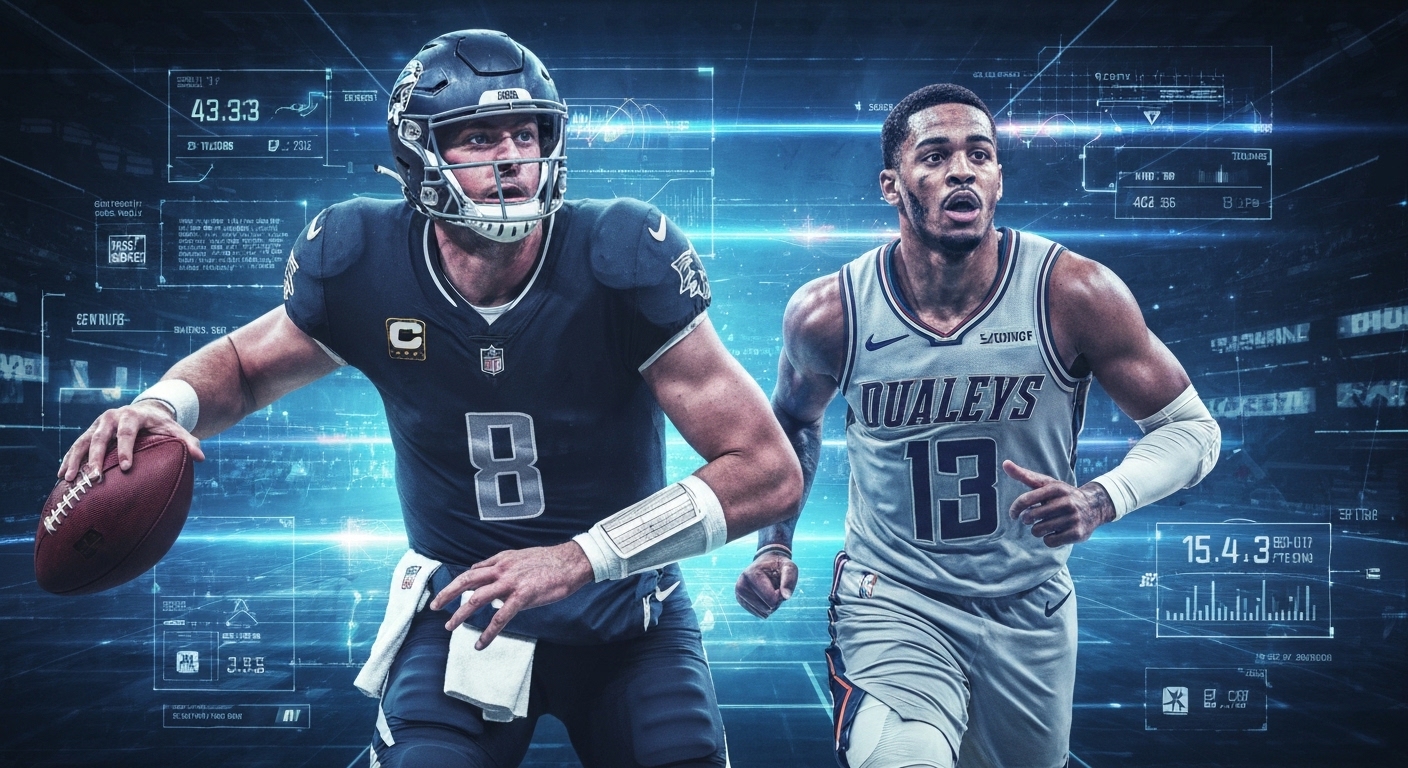
2026: How Advanced Analytics Reshape NFL & NBA Strategies
The era of Moneyball is over. Not because it was wrong, but because its lessons have been so thoroughly absorbed that simply counting stats feels quaint. Welcome to 2026, where the conversation has moved far beyond on-base percentages. We’re now in the age of predictive, real-time, and deeply integrated analytics. This article explores how advanced analytics reshape NFL NBA strategies 2026, moving from front-office theory to the on-field and on-court realities that define every game. The convergence of artificial intelligence, computer vision, and wearable technology has created an entirely new strategic layer in professional sports, influencing everything from split-second play calls to decade-defining player contracts.
The Core Technologies Driving the Analytics Revolution
To understand the strategic shifts, you first need to look inside the engine room. The revolution isn’t just about having more data; it’s about having new types of data and the powerful tools to make sense of it. These core technologies are the foundation upon which modern sports empires are being built.
-
Wearable Biometric Sensors: Tiny sensors embedded in everything from shoulder pads to jerseys now track much more than just location. They monitor player load, acceleration, deceleration, heart rate, and even sleep patterns. This provides a detailed physiological profile, allowing teams to manage fatigue, optimize practice reps, and predict injury risk with startling accuracy.
-
Computer Vision & Player Tracking: This is the all-seeing eye. A network of high-frame-rate cameras installed in stadiums captures the precise x-y-z coordinates of every player and the ball 25 times per second. This turns a chaotic game into a structured dataset, allowing analysts to measure receiver separation, defensive rotation efficiency, and thousands of other metrics that were once invisible.
-
Artificial Intelligence & Machine Learning (AI/ML): This is the brain of the operation. AI models process the terabytes of data from wearables and computer vision to identify complex patterns that a human could never see. These systems can predict the success probability of a specific play against a specific defense, identify undervalued players in the draft, and even help shape real-time odds and analysis for an increasingly data-savvy audience.
How Advanced Analytics Reshape NFL Strategies
The stop-and-start nature of American football makes it uniquely suited for analytical deep dives. With each play serving as a discrete event, teams have a treasure trove of data to inform their next move.
In-Game Tactical Decisions
The most visible impact of analytics is on situational football. The days of a coach “going with his gut” on fourth down are numbered. Today, coaches on the sideline have access to tablets showing real-time win probability models. These models calculate the expected value of going for it, punting, or kicking a field goal based on down, distance, field position, and opponent strength. This data-driven approach has led to a league-wide increase in aggressive fourth-down attempts, as teams now understand the statistical advantage.
Beyond fourth downs, play-calling is becoming a science. Quarterbacks can see pre-snap defensive alignment probabilities, while offensive coordinators use models to script opening drives that exploit a defense’s most common tendencies. Defensive coordinators, in turn, use analytics to determine the optimal blitz packages against specific offensive line combinations.
Player Evaluation and Roster Construction
The NFL Combine is still a spectacle, but front offices now place far more weight on in-game analytics. Using player-tracking data, teams can measure a wide receiver’s “separation” from a defender in tenths of a second or a pass rusher’s “time to pressure” the quarterback. These metrics are far more indicative of on-field success than a 40-yard dash time.
This data-rich environment has also transformed scouting and the draft. As noted by experts, the impact of AI analytics on NFL draft strategies is profound. Models can sift through thousands of college players, flagging those whose in-game metrics translate best to the pro level, often uncovering hidden gems that traditional scouting might miss.
Injury Prevention and Load Management
Perhaps the most significant, yet least visible, application is in player health. By using data from wearable sensors, sports science departments can precisely monitor a player’s “load.” If a running back’s data shows an unusually high number of high-impact collisions and decelerations in a week of practice, his reps may be scaled back to prevent a non-contact hamstring or ACL injury. This proactive approach to health keeps star players on the field, which is the single most important factor in winning.
How Advanced Analytics Reshape NBA Strategies
While the NFL’s game is one of discrete events, the NBA’s is a study in fluid motion. This presents a different set of challenges and opportunities for analytics, which have fundamentally altered the geometry of the court.
The Evolution of Shot Selection
The first wave of basketball analytics was defined by the “Moreyball” revolution: a relentless pursuit of the most efficient shots—three-pointers and layups—and the near-abandonment of the mid-range jumper. By 2026, this philosophy has become more nuanced. The sheer volume of game data, with nearly 60,000 minutes of game time logged in a season, allows for deeper analysis.
Now, it’s not just about where you shoot from, but how. Player-tracking data allows teams to calculate “Expected Possession Value” (EPV) in real-time. An open 18-foot jumper by an elite shooter might be a better shot than a heavily contested three-pointer by a mediocre one. This has led to offenses focused on “shot quality generation”—using complex movements and passing sequences to create the highest-probability look on any given possession.
Defensive Versatility and Lineup Optimization
On defense, analytics has moved beyond simple blocks and steals. Teams now track “rim contests,” “defensive rotation speed,” and “pick-and-roll coverage efficiency.” The most prized defenders in 2026 are not necessarily shot blockers, but versatile players who can switch across multiple positions without creating a mismatch—a quantifiable trait called “defensive versatility.”
This ties directly into lineup optimization. Coaches are no longer just playing their five “best” players; they’re playing their most effective five-man units. Advanced stats like “Net Rating” (the point differential per 100 possessions) for specific lineups are paramount. AI models can even run simulations to predict which lineup combinations will perform best against an opponent’s likely rotations, giving coaches a data-driven game plan before the opening tip.
NFL vs. NBA: A Tale of Two Data Sets
The reason analytics manifests so differently in the two leagues comes down to the fundamental structure of their data.
In the NFL, the data is event-based. A play happens, it ends, and a new set of data is logged. This makes it ideal for situational analysis, like the aforementioned fourth-down decisions. The primary challenge is credit attribution. With 22 players on the field, it’s incredibly difficult to isolate the exact reason for a play’s success or failure. Was the touchdown a result of a great throw, a brilliant route, a missed tackle, or a blown coverage? Analytics aims to untangle that web.
In the NBA, the data is continuous and spatial. The game is a constant flow of interactions, and player location is everything. The challenge here is quantifying off-ball actions and complex chain reactions. How do you measure the value of a player setting a perfect screen that leads to a hockey assist two passes later? The analytics focus is on efficiency, spatial relationships (e.g., “gravity” of shooters pulling defenders away), and the synergy between players in a lineup.
The Human Element: Challenges and the Future of Sports Analytics
For all the advancements, the integration of analytics is not without its hurdles. The human element remains the most critical—and most complex—variable.
One major challenge is the “black box” problem. An AI model might recommend a counterintuitive strategy, but if it can’t explain why it’s the best option, a coach is unlikely to trust it during a championship game. This has led to a push for “Explainable AI” (XAI) that can translate complex calculations into understandable coaching insights.
There’s also the risk of data overload. As one report notes, a key is integrating analytics into training regimens effectively, not just collecting endless statistics. The teams that succeed are not the ones with the most data, but the ones with the best translators—analysts who can bridge the gap between the data science department and the locker room.
Finally, there’s the timeless debate of analytics versus intuition. Can a spreadsheet measure a player’s leadership, competitive fire, or ability to perform in the clutch? The most successful organizations in 2026 don’t see it as an either/or proposition. They use analytics as a powerful tool to inform decisions, challenge biases, and uncover blind spots, while still valuing the experience and intuition of their coaches and scouts.
Conclusion: The Game Has Changed, and There’s No Going Back
By 2026, advanced analytics are no longer a niche curiosity or a competitive edge; they are the cost of admission. They have fundamentally and irrevocably reshaped strategy in the NFL and NBA. The impact is felt everywhere: in the aggressive, data-informed play calls on fourth down, in the geometric precision of an NBA offense, in the construction of rosters, and in the quiet work of keeping athletes healthy. The game has changed, and there is no going back. The next wave will only deepen this integration, using data to create more personalized training, faster real-time feedback loops, and a richer, more insightful experience for the fans watching at home.
Frequently Asked Questions
How are advanced analytics, including AI, expected to influence NFL Draft strategies by 2026?
By 2026, advanced analytics and AI will significantly refine NFL Draft strategies through predictive modeling. Teams will leverage data to assess player potential, project injury risk, and determine optimal scheme fit with greater precision, moving beyond traditional scouting methods to build more effective rosters.
How do advanced analytics reshape how NBA teams evaluate players?
Advanced analytics in the NBA move beyond basic statistics to evaluate players through granular performance metrics, efficiency ratings, and synergy with teammates. This allows teams to identify undervalued talent, optimize roster construction, and understand how players contribute to team success in complex ways beyond traditional box scores.
What core technologies are driving the advanced analytics revolution in NFL and NBA by 2026?
The advanced analytics revolution in sports by 2026 is powered by technologies like artificial intelligence (AI), machine learning, and sophisticated computer vision systems. These are complemented by wearable sensors, advanced tracking data, and robust cloud computing infrastructure for processing vast datasets in real-time.
Could the widespread adoption of advanced analytics make NFL and NBA games less entertaining?
While some fear analytics might lead to predictable play, the article suggests they can enhance strategic depth and innovation, potentially making games more engaging for informed viewers. The challenge lies in balancing data-driven decisions with the human element of instinct and creativity to maintain entertainment value and unpredictability.
What are the key differences in data sets and analytical approaches between the NFL and NBA?
The NFL’s data is characterized by discrete, high-impact plays with significant variability, often focusing on injury prevention, situational probabilities, and player matchups. In contrast, the NBA generates continuous, fluid data, emphasizing individual player tracking, efficiency metrics, and dynamic team interactions within a constant flow of action.