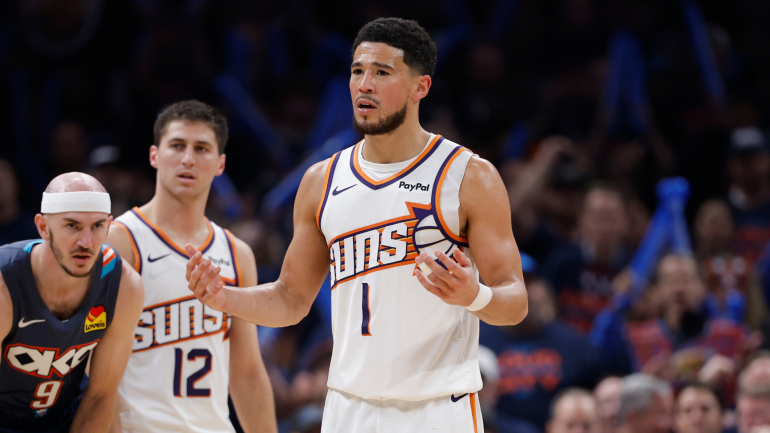
What happened in the Suns vs. Thunder Game 2 matchup?
What happened in the Suns vs. Thunder Game 2 matchup? The Oklahoma City Thunder defeated the Phoenix Suns 120-107 to take a 2-0 lead in their Western Conference First Round series.
The defending champion Thunder controlled the game through efficient half-court execution and transition scoring. However, the primary storyline emerged late in the third quarter when Phoenix guard Devin Booker received a controversial technical foul.
Following the game, Booker publicly criticized referee James Williams, stating the NBA risks looking like the "WWE." The incident highlighted Phoenix's loss of defensive discipline and Oklahoma City's ability to capitalize on emotional volatility.
Game 2 Key Takeaways & Overview Stats:
Final Score: Thunder 120, Suns 107 (OKC leads series 2-0).
Player Performance: Shai Gilgeous-Alexander recorded 37 points (13-of-25 FG, 9-of-9 FT).
Suns Scoring: Dillon Brooks scored 30 points; Devin Booker added 22 points (7-of-14 FG) but struggled with turnovers.
Turning Point: A Devin Booker technical foul in the third quarter triggered a decisive Thunder scoring run.
Key Metric: Oklahoma City generated a significant advantage in transition, outscoring Phoenix's bench and capitalizing on live-ball turnovers.
How did the game unfold and what caused the Devin Booker technical foul?
Oklahoma City dictated the pace from the opening tip. They established a 118.5 offensive rating in the first half by attacking the paint and forcing Phoenix into rotation. By the third quarter, the Thunder built an 18-point advantage (93-75), forcing the Suns to play from behind against a set defense.
What was the exact play that led to the controversy?
The turning point occurred late in the third quarter during a loose-ball sequence. Devin Booker dove toward the sideline to save a possession. He collided with Thunder forward Jaylin Williams and subsequently threw the basketball off Williams to secure an out-of-bounds call for Phoenix.
Why did the referees assess a technical foul?
The officials initially paused the game to review the physical collision. During this stoppage, Thunder guard Alex Caruso openly lobbied the officiating crew. Referee J.B. DeRosa then assessed a retroactive Devin Booker technical foul. This decision halted Phoenix's momentum. It shifted the focus from basketball execution to officiating disputes, and the Suns failed to string together consecutive defensive stops for the remainder of the quarter.
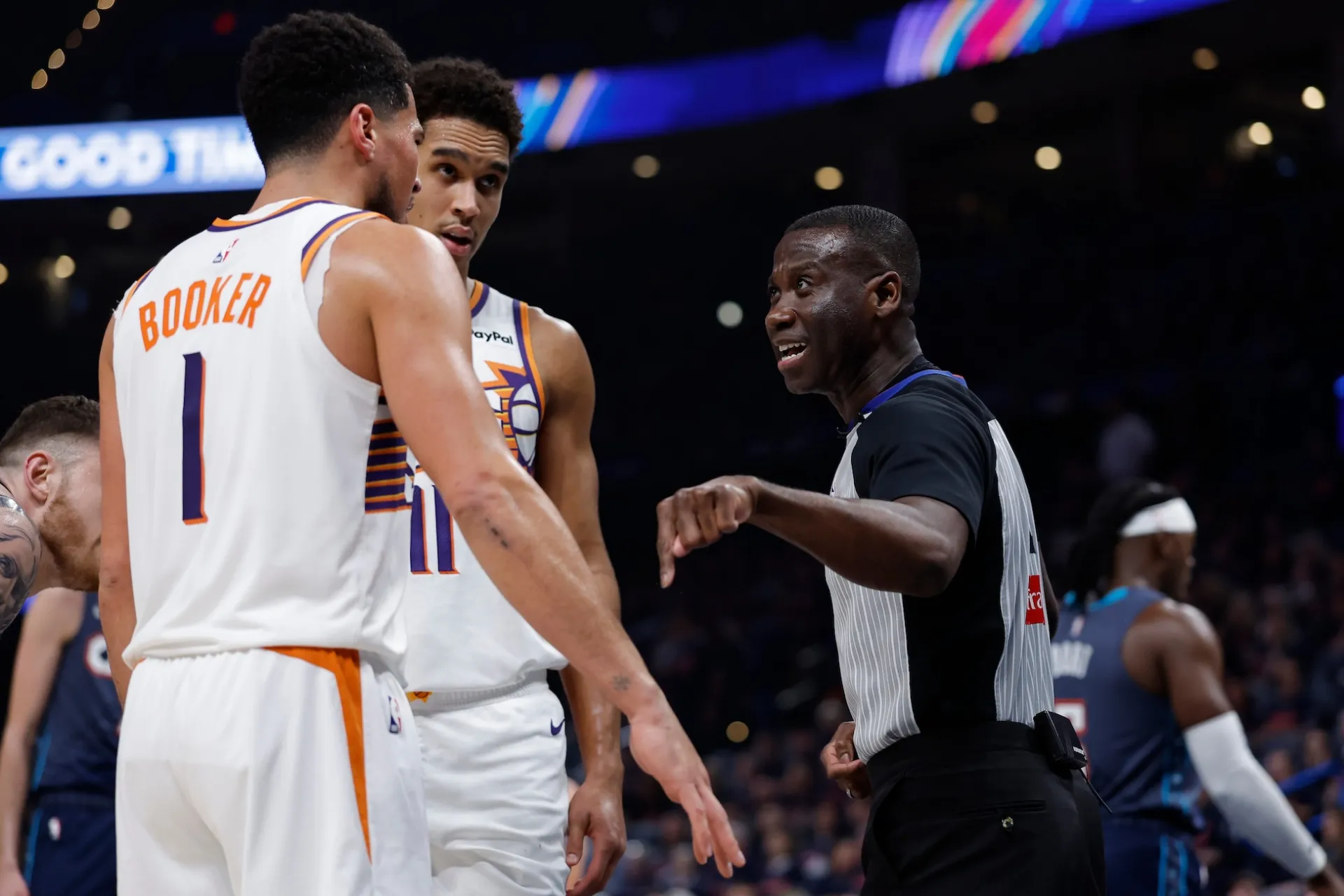
Why did the Thunder win Game 2?
The Thunder won because they exploited Phoenix's pick-and-roll coverages and maintained superior shot quality. Oklahoma City recorded 28 assists and restricted their unforced errors, which allowed them to generate high-percentage looks at the rim and from the perimeter.
How did Oklahoma City's offense dismantle the Suns' defense?
Oklahoma City utilized five-out spacing to neutralize Phoenix's rim protection. By placing shooters in both corners, they created wide driving lanes for their ball-handlers. Shai Gilgeous-Alexander repeatedly attacked Phoenix's drop coverage. He forced the Suns' big men to commit, which opened up lob opportunities and kick-out three-pointers.
What caused Phoenix's defensive breakdown in the second half?
Phoenix lost their structural discipline. Following the Devin Booker technical foul, the Suns began pressing aggressively on the perimeter. This over-extension led to compromised closeouts. Oklahoma City capitalized by driving past initial defenders, forcing secondary rotations, and finding unguarded shooters. The Suns' transition defense also failed. They routinely complained to officials after missed layups, resulting in a severe deficit in fast-break points.
Who were the standout performers and why?
Game 2 highlighted a stark contrast in star efficiency. Shai Gilgeous-Alexander controlled the game's tempo, while Phoenix's primary scorers struggled to balance volume with efficiency.
How did Shai Gilgeous-Alexander control the game?
Gilgeous-Alexander delivered an elite offensive performance. He scored 37 points on 13-of-25 shooting from the field. More importantly, he shot a perfect 9-of-9 from the free-throw line. He utilized hesitation dribbles to keep Phoenix defenders off-balance, drawing contact in the paint without committing offensive fouls. His true shooting percentage (TS%) exceeded 65%, underscoring his ability to generate efficient offense against a physical defense.
Why did Devin Booker and the Suns' offense stall?
Booker finished with 22 points, seven rebounds, and four assists in 40 minutes of action. He shot an efficient 7-of-14 from the floor, but his overall impact was muted by high turnover rates and foul trouble. The Thunder deployed Alex Caruso as the primary defender on Booker. Caruso navigated screens effectively, denied Booker early post touches, and forced him to initiate the offense further from the basket than usual.
Dillon Brooks provided an unexpected scoring surge. He recorded 30 points, shooting efficiently from beyond the arc to keep the game within reach. However, Brooks also succumbed to frustration, picking up his fifth foul and engaging in a double-technical confrontation with Gilgeous-Alexander late in the fourth quarter.
What structural weaknesses did this playoff matchup reveal?
Game 2 exposed severe flaws in Phoenix's roster construction and on-court maturity. Oklahoma City demonstrated the value of a deep rotation and defensive versatility.
What are the Suns' biggest tactical flaws?
Phoenix lacks reliable point-of-attack defense. When Oklahoma City initiated high ball screens, the Suns' guards frequently died on screens, forcing their centers into two-on-one disadvantages. Furthermore, Phoenix's bench failed to provide adequate scoring relief. The lack of secondary shot-creation forced Booker and Brooks into high-usage roles, leading to late-game fatigue and poor shot selection under pressure.
What makes the Thunder so difficult to defend?
The Thunder excel at drive-and-kick basketball. They do not rely on a single offensive hub. If Gilgeous-Alexander faces a double-team, Oklahoma City moves the ball rapidly to the weak side, attacking the defense before it can reset. Their ability to maintain a fast pace without sacrificing ball security gives them a distinct mathematical advantage in possession quality.
What do the NBA stats say about the referee bias narrative?
Following the game, Booker expressed severe frustration with referee James Williams. He claimed a lack of respect and suggested the officiating dynamics resembled scripted entertainment. However, the game data tells a different story regarding foul distribution.
Was there a legitimate free-throw disparity?
The surface-level NBA stats do not support the narrative of a heavily biased whistle. Oklahoma City shot only three more free throws than Phoenix over 48 minutes. Furthermore, the total personal foul count was nearly identical, with the Suns committing just four more infractions than the Thunder.
Why does Oklahoma City naturally draw more fouls?
Advanced stats explain the whistle perception. Oklahoma City leads the league in drives per game. Teams that relentlessly attack the restricted area naturally generate more free-throw attempts than teams relying heavily on mid-range jump shots. Phoenix's offense is structurally designed around isolation jump-shooting, which traditionally yields lower free-throw rates. The Devin Booker technical foul amplified the emotion of the game, but it did not reflect a systemic statistical bias.
How does this impact the NBA playoff standings and series odds?
The 120-107 victory pushes Oklahoma City to a commanding 2-0 series lead. For Phoenix, the mathematical reality of their situation is dire as the series shifts to the Footprint Center.
What is the historical context of a 2-0 playoff deficit?
In the history of the NBA playoffs, teams trailing 2-0 win the series less than 8% of the time. This percentage drops even further when the trailing team is facing the defending champions. Phoenix has lost home-court advantage and must now win four of the next five games against a team that has thoroughly dismantled their defensive schemes.
What must the Suns adjust for Game 3?
Phoenix faces an absolute must-win scenario in Game 3. To avoid a 3-0 deficit, head coach and the coaching staff must implement immediate tactical and psychological adjustments.
How can Phoenix fix their defensive rotations?
The Suns must adjust their pick-and-roll coverage. Instead of playing deep drop coverage, they should experiment with blitzing Gilgeous-Alexander to force the ball out of his hands early in the shot clock. This requires crisp weak-side rotations and a commitment to closing out on Oklahoma City's corner shooters.
How can the Suns optimize Devin Booker's offense?
Phoenix must scheme easier looks for their franchise player. Running Booker off off-ball screens and dribble hand-offs will prevent Alex Caruso from establishing static defensive position. If the Suns can get Booker attacking a moving defense, they can increase their restricted-area field goal attempts, naturally draw more fouls, and mitigate the transition opportunities that fueled Oklahoma City's Game 2 victory.
Ultimately, Phoenix must regain their composure. If they spend Game 3 focusing on the officiating rather than their transition defense, their postseason run will end abruptly.